
Beyond the logo
In this article, Kirsty Nelms, director of marketing agency Peacock Digital Marketing, will cover each part of the logo design process and some key questions to ask your graphic designer.
Table of Contents
Phase 1: Getting to know your business
The logo design process begins with a crucial step: understanding the business. When you developed your business plan, you likely covered your core values. Sometimes, this can feel like a bit of a ‘tick box’ exercise as part of whatever business plan template you may be following, but it is honestly one of the most important things to get right.
You’ll be looking to your values to guide your future business decisions, such as who to hire, how to handle difficult situations and which clients to work with.
Your brand needs to reflect those values, so it’s vital that you have taken the time to establish what they are.
Tip: A great exercise is to ask your customers, focus groups, colleagues, or other people who know what it’s like to receive your service or products for four words that describe that feeling. Do they think you come across as energised and innovative? Do you always seek out creative solutions? Are you the sort of business which really values community?
Once you’ve established your values, vision and mission, you’re ready to talk to a graphic designer about developing your brand.
During this initial meeting, they will also ask you if there is any symbolism you would associate with your business, if you have any preferences for styles or colours. If you can supply a few logos from other companies (it could be in a completely different industry) that you like and say what you like about them, that will help the designer get a sense for your style.
The designer will also be able to advise on context, because while you might like a quirky handwritten font for your law firm, it might not necessarily resonate with your target demographic. Or it might! It depends on your values and your target market.
Phase 2: Further research and design concepts
At this stage, it’s back over to the designer to further investigate the industry landscape and competitors. They’ll look at what’s already out there, what clichés to avoid, what could be done differently to stand out, and other graphic design techniques which might be appropriate to the project.
They will then use that research to come up with a few initial logo design concepts, either in sketch form or digitally before converting their sketches to vector formats using their graphic design software.
Phase 3: Refining early designs and preparing 2-3 concepts
The designer will further refine the early concepts and try pairing any graphic elements with typography, or shaping any typography they had in mind. They’ll also experiment with shapes and layouts. Sometimes, these drafts will be presented to the client in monochrome, so as not to distract from the form. Around 2-3 different concepts will be presented to the client.
Phase 4: Feedback
Feedback time! This is the client’s chance to share their thoughts and discuss with the designer any tweaks. It might be that a few designs are combined to create something which is a blend of both.
It’s really important at this stage for clients to articulate what they want. Simply saying ‘make it pop’, or ‘I don’t like it’, will not help the designer to refine the branding. You could explain why you feel the design isn’t as eye catching as you would like, and what you feel could be more effective. You could explain why you don’t like a particular style and suggest an alternative style (even if it’s just showing a few images of what you mean). By taking an open approach to communication, you will be well on your way to receiving the brand you’ve always wanted.
Phase 5: Refined design and supporting elements
A final design will be created based on the feedback, and once that has been signed off by the client, multiple versions of the logo will be created. These could include stacked versions, favicons, and versions for light and dark backgrounds.
At this stage, depending upon the budget, additional supporting graphic elements would be created, such as bespoke illustrations or repeat patterns. These will form part of the wider brand and make it a lot easier to convey a strong sense of identity in all future projects.
Phase 6: The grand finale
Once everything receives final sign off, each variation of the logo will be exported in various formats, such as: PNG, JPEG, SVG. A brand guidelines document will also be created (sometimes this is just a single page for lower budget projects, or a full brand book for larger companies). This is essentially a sacred tome that ensures consistency across all media. Typography rules, colour codes, and logo usage guidelines – it’s all in there. The client can now confidently pass this to future designers, ensuring a harmonious brand identity.
Branding is more than just a logo
By understanding each stage of the logo design process, you can grasp how much work goes into crafting a brand which truly reflects your business.
When selecting a graphic design agency to create your branding, consider these questions…
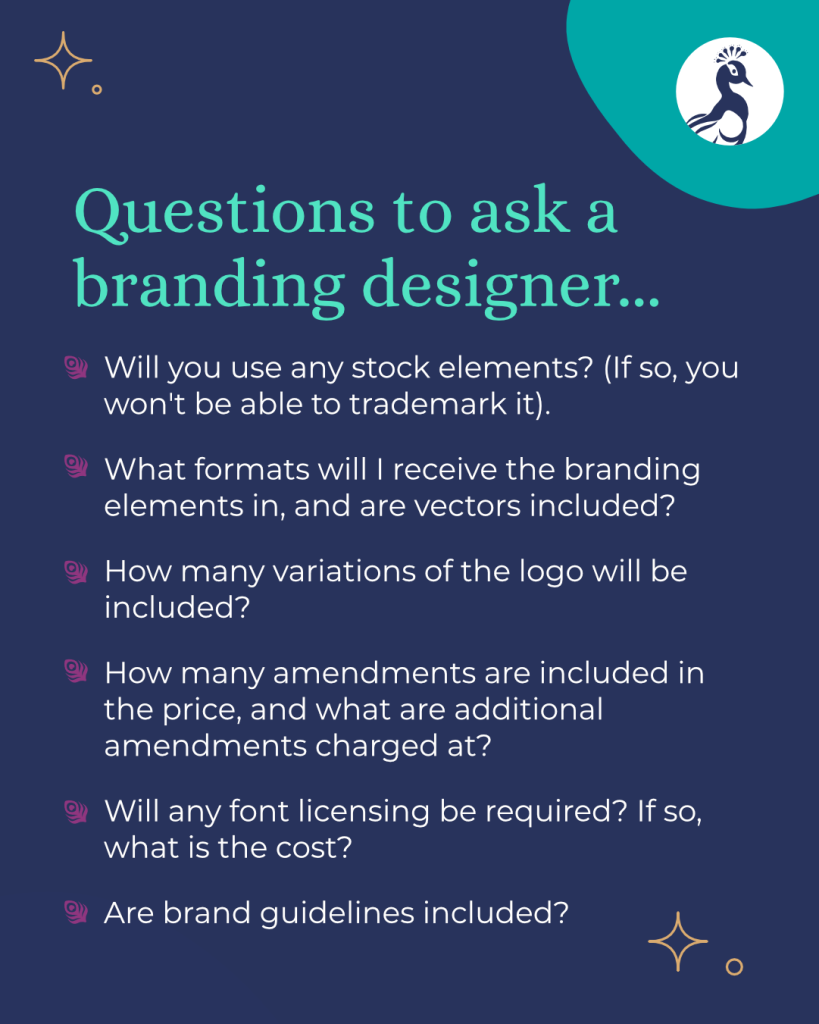
Will you use any stock elements? (This is one of the main reasons you should never use a free logo maker for your company branding).
What formats will I receive the branding elements in, and are vectors included?
How many variations of the logo will be included?
How many amendments are included in the price, and what are additional amendments charged at?
Will any font licensing be required? If so, what is the cost?
Are brand guidelines included?
About the author
Kirsty Nelms is the Director of Staffordshire-based creative marketing agency, Peacock Digital Marketing. She grows businesses through proactive, creative, insightful marketing – helping brands to strut their stuff 🦚.
She holds a first-class honours degree in Journalism and Editorial Design, has six years of experience as a qualified senior journalist, seven years of experience working at senior level in marketing, holds a Postgraduate Diploma in Digital Marketing from the Digital Marketing Institute, and a number of other advanced-level SEO qualifications.
Connect with her on LinkedIn, sign up for Peacock Digital Marketing’s email newsletter for free marketing tips and goodies, or follow her blog.


